
Do You Read the Qur’an Looking for Answers?
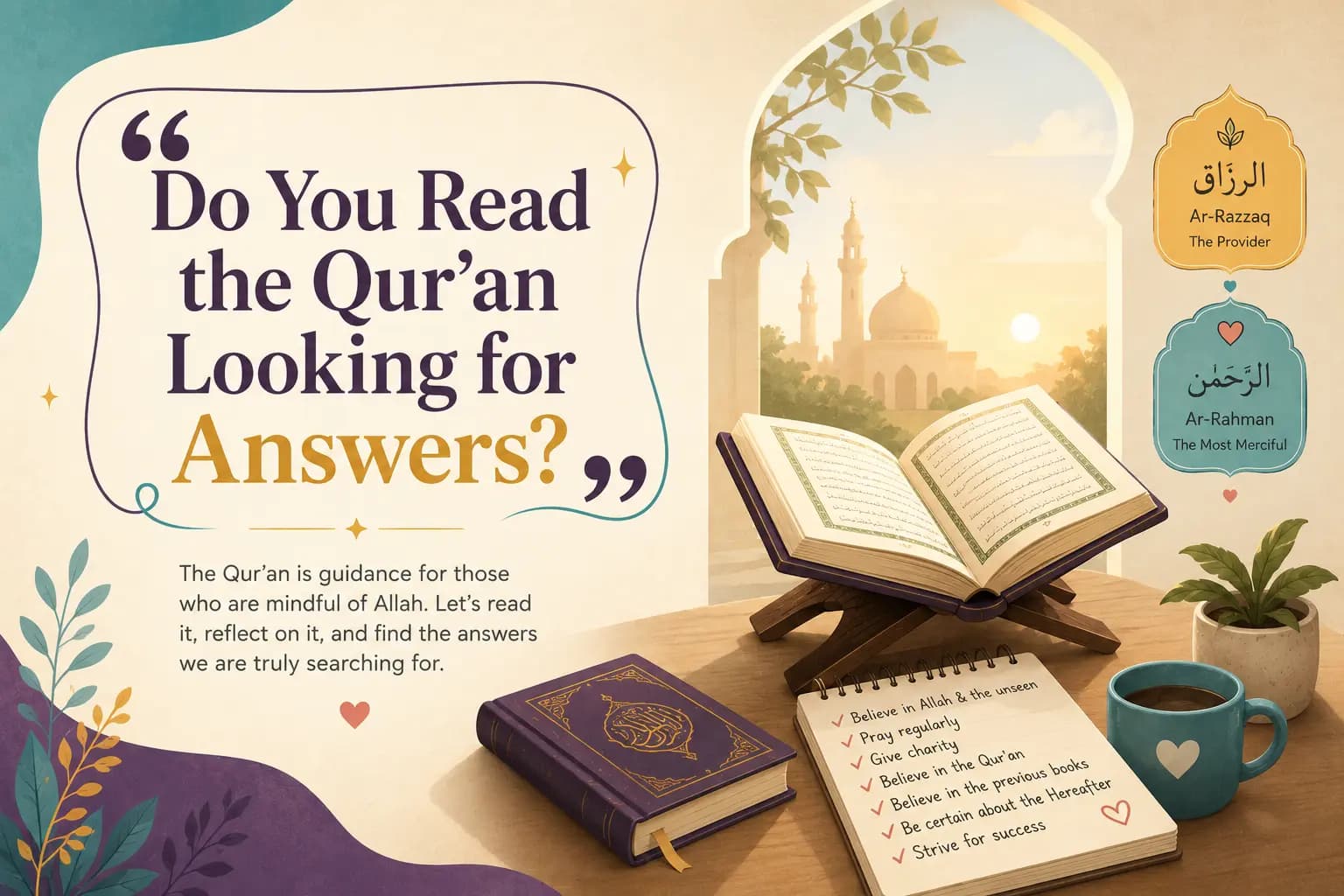
Do You Read the Qur’an Looking for Answers?
Many of us read the Qur’an regularly. We may recite a page, complete our daily portion, or listen to a beautiful recitation. But have we ever tried to read the Qur’an like someone who is genuinely looking for an answer?
This small change in intention can affect how we approach the Qur’an. Instead of only asking, “How much did I read today?”, we can also ask, “What is Allah teaching me through these verses?”
The opening verses of Surah Al-Baqarah give us a simple example. They tell us that the Qur’an is guidance, describe the people who benefit from that guidance, and explain what true success looks like.
The Qur’an Is Guidance for Those Mindful of Allah
Surah Al-Baqarah is the second surah in the Qur’an. After the opening letters, Alif Laam Meem, Allah describes the Qur’an as a Book in which there is no doubt and as guidance for those who are mindful of Him.
“This is the Book, without doubt, a guidance for those who are mindful of Allah.”
The verse immediately gives us something to reflect upon. The Qur’an is guidance, but the people mentioned here are not approaching it carelessly. They are mindful of Allah and want to live in a way that pleases Him.
A sincere reader may now ask, “I want to be among those who are mindful of Allah. What qualities should I develop?”
The answer does not require us to leave the passage or invent our own explanation. The following verses describe these people and show us how faith appears in their beliefs, worship, and actions.
They Believe in the Unseen
The first quality mentioned is belief in the unseen. Muslims believe in realities that cannot be discovered through the senses alone because Allah and His Messenger ﷺ have informed us about them.
This includes belief in Allah, His angels, His Messengers, the Day of Judgement, and the other matters of the unseen established through revelation.
Belief in the unseen teaches us that reality is greater than only what we can see and touch. A believer builds their understanding of life upon revelation, not only upon personal experience or what is visible in front of them.
They Establish the Prayer
The verses then describe those who establish the prayer. Salah is not treated as an occasional activity or something remembered only when life becomes difficult. It is a regular and central part of the believer’s life.
Muslims are required to perform the five daily prayers at their prescribed times. Establishing prayer also means taking it seriously, learning how to perform it correctly, and trying to pray with humility and awareness.
For parents, this is an important lesson to teach gradually. We should not only tell children that they must pray. We should help them understand who they are standing before, why Salah matters, and how prayer keeps their relationship with Allah alive throughout the day.
They Give From What Allah Has Provided
The next quality is spending from what Allah has provided. This wording teaches us an important lesson about wealth: whatever we possess reached us through the provision and permission of Allah.
“And they give from what We have provided them.”
When a Muslim gives charity, they are not simply giving from something they created entirely by themselves. Their health, opportunities, abilities, work, and wealth are all blessings provided by Allah.
Understanding this can protect the heart from arrogance and excessive attachment to money. Charity becomes an act of gratitude, trust, and obedience rather than merely losing part of what we own.
This is also a valuable principle to teach children. Even when a child has only a small amount to give, they can learn that generosity is part of faith and that the blessings they receive come from Allah.
They Believe in All of Allah’s Revelation
The passage then describes those who believe in what was revealed to Prophet Muhammad ﷺ and in what was revealed before him.
Muslims believe in the Qur’an revealed to Prophet Muhammad ﷺ. They also believe that Allah sent revelation to previous Prophets, including the original books revealed before the Qur’an.
This reminds us that the message of Islam is connected to the long history of Prophethood. Muslims believe in all the Prophets of Allah and do not reject one Prophet while accepting another.
They Are Certain About the Hereafter
The believers described in these verses are certain about the Hereafter. They know that this worldly life is temporary and that they will return to Allah.
Certainty in the Hereafter changes the way a person lives. Choices are no longer based only on immediate comfort, popularity, money, or what other people think. The believer remembers that their actions have consequences and that true success will be known when they meet Allah.
Children also need to understand the Hereafter in a balanced and age-appropriate way. It should not be taught only as a collection of frightening details. Belief in the Hereafter gives life meaning, encourages responsibility, and reminds children that Allah rewards sincere faith and good deeds.
What Does the Qur’an Say About True Success?
After describing these qualities, Allah tells us the result. These people are upon guidance from their Lord, and they are the successful ones.
“They are truly guided by their Lord, and they are the successful ones.”
This gives us an answer to one of the most important questions a person can ask: What does it mean to be truly successful?
Success is not measured only by wealth, qualifications, popularity, or professional achievements. These things may be blessings, but the opening verses of Surah Al-Baqarah connect true success to faith, prayer, generosity, revelation, and certainty in the Hereafter.
- Believe in Allah and the unseen.
- Establish the five daily prayers.
- Give from what Allah has provided.
- Believe in the Qur’an revealed to Prophet Muhammad ﷺ.
- Believe in the revelation sent to the previous Prophets.
- Remain certain about the Hereafter.
- Continue trying to live by these beliefs until you meet Allah.
This does not mean that believers never struggle or make mistakes. It means that they know the path they are trying to follow, return to Allah when they fall short, and continue working towards the qualities He has praised.
How Can You Read the Qur’an Looking for Answers?
Reading the Qur’an looking for answers does not mean opening it randomly and treating the first verse you see as a personal prediction. It means reading carefully, understanding the passage in its context, and asking what Allah is teaching through it.
Begin with a clear question. Read a short passage with a trustworthy translation, and notice whether the following verses explain the answer, describe important qualities, give a command, provide a warning, or show a result.
- What question does this passage answer?
- What does it teach me about Allah?
- What beliefs does it ask me to hold?
- What actions does it encourage?
- What behaviour does it warn me against?
- What result does Allah promise or describe?
- How can I apply this lesson correctly in my life?
When the meaning is unclear, refer to reliable Tafseer or ask a qualified teacher. Qur’anic reflection should help us understand revelation more carefully, not encourage us to remove verses from their context or create meanings without knowledge.
How Parents Can Practise Qur’anic Reflection With Children
Parents can use the same method with children after reading or memorising a short passage. The discussion does not need to be long or academically complicated.
For example, after reading the opening verses of Surah Al-Baqarah, a parent could ask, “What qualities does Allah mention here?” The child can then identify belief, prayer, charity, revelation, and certainty in the Hereafter.
The parent can follow with one practical question: “Which of these qualities can we work on today?” This helps the child move from reciting the words to recognising what Allah is teaching through them.
The goal is not to make every child produce a deep Tafseer. The goal is to teach them that the Qur’an contains guidance they should listen to, understand, and try to follow.
Read the Qur’an Like Someone Who Needs Its Guidance
The next time you read the Qur’an, slow down and approach the verses with a sincere question. Do not focus only on reaching the end of the page. Look at how the ideas connect and what answer the passage is giving you.
The opening verses of Surah Al-Baqarah show us a clear path: believe in the unseen, establish prayer, give from what Allah has provided, believe in His revelation, and remain certain about the Hereafter.
These are not merely facts to memorise. They are qualities to build throughout our lives. We will not practise them perfectly, but we can continue learning, repenting, and trying until we meet Allah.
At Norulamal Academy, we want children to learn how to recite and memorise the Qur’an while also understanding its message. Qur’an education should help children recognise Allah’s guidance and connect it to the way they believe, worship, and live.
Frequently Asked Questions
How can I find answers in the Qur’an?
Begin with a sincere question, read a relevant passage carefully, and study its meaning through a trustworthy translation and reliable Tafseer. Notice the beliefs, actions, warnings, and results mentioned in the verses. Qur’anic guidance should be understood in context rather than by opening the Qur’an randomly and treating one verse as a personal prediction.
What do the opening verses of Surah Al-Baqarah teach?
The opening verses teach that the Qur’an is guidance for those mindful of Allah. They describe believers as people who believe in the unseen, establish prayer, give from Allah’s provision, believe in His revelations, and remain certain about the Hereafter. Allah describes them as guided and successful.
What does success mean in Surah Al-Baqarah?
In the opening verses of Surah Al-Baqarah, success is connected to guidance from Allah. The successful believers have faith in the unseen, establish prayer, give from their provision, believe in Allah’s revelation, and have certainty in the Hereafter.
How can parents teach children to reflect on the Qur’an?
After reading or memorising a short passage, explain its meaning in simple language and ask one or two clear questions. Ask what Allah is teaching, which qualities are mentioned, and how the child can apply one lesson. Use reliable Tafseer or a qualified teacher when the passage needs deeper explanation.