
How to Find Guidance Through the Qur’an?
What Would You Do With a Message You Could Not Understand?
Imagine that you are facing a serious problem. A close friend tells you, “I am going to send you a message that contains the solution you need.”
The message arrives, but when you open it, you discover that it is written in a language you do not understand. Imagine, for example, that it is written in Chinese and you cannot read Chinese.
Would you continue reading and repeating the message without knowing what it means? Or would you look for a reliable translation so you could understand the message and begin following its guidance?
Most of us would want to understand it. The message is too important to leave unexplained.
The Qur’an Was Sent as Guidance
The Qur’an is not only a book that Muslims recite. Allah sent the Qur’an as guidance for humanity. It teaches us about Allah, our purpose in life, what happens after death, and how we should live.
Reciting the Qur’an correctly is important. Learning Tajweed is important. Memorising the Qur’an is a great act of worship. But if we never try to understand what we are reading, we may miss much of the guidance that the Qur’an is giving us.
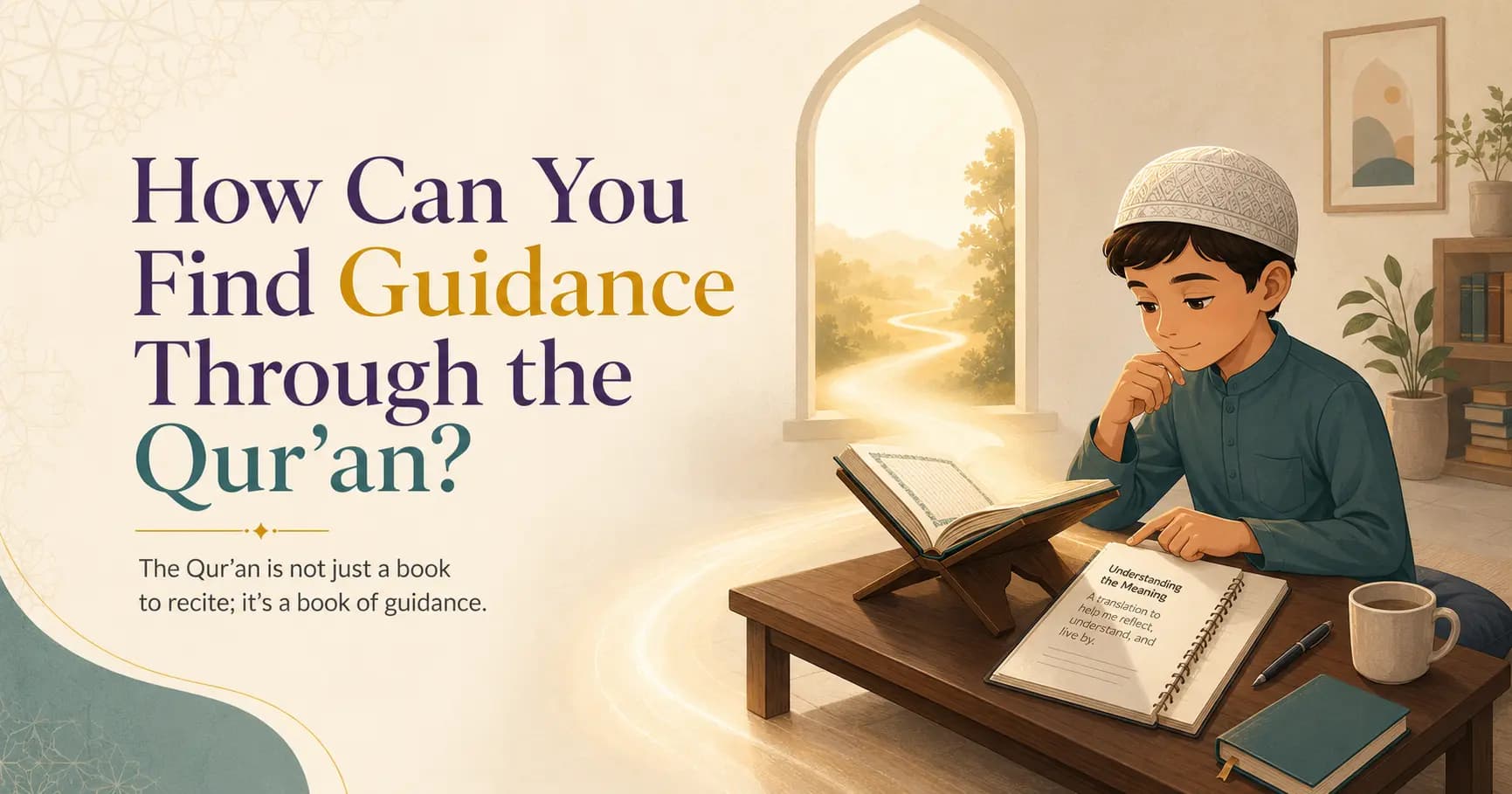
The Qur’an is not just a book to recite. It is a book of guidance.
This is especially important for non-Arabic-speaking Muslims. A person may learn to pronounce the Arabic beautifully while still not knowing what the ayah is teaching them. Correct recitation and understanding should support one another rather than compete with one another.
How Can You Find Guidance Through the Qur’an?
You can begin finding guidance through the Qur’an by reading it, learning the meaning of what you read, reflecting on its message, and asking how that message should affect your life. The goal is not only to finish pages but to understand what Allah is teaching you.
After reading an ayah, pause for a moment. Read a trustworthy translation in a language you understand. Then think carefully about the meaning.
- What is Allah teaching me in this ayah?
- What does this ayah teach me about Allah?
- Is there something I need to change in my behaviour?
- Is there something I should believe, remember, or be grateful for?
- How can I apply this guidance in my everyday life?
You do not need to answer every question immediately. Some verses require deeper study and explanation. The important thing is to begin approaching the Qur’an with the intention of understanding its guidance rather than treating reading as a task to complete.
Is Reciting the Qur’an Enough Without Understanding It?
Reciting the Qur’an is itself an important act of worship, and a Muslim should never feel that recitation has no value simply because they do not yet understand Arabic. However, understanding the meaning helps us connect the words we recite to our beliefs, decisions, character, and daily life.
The goal should therefore not be to choose between recitation and understanding. We can work on both.
A Muslim can improve their pronunciation and Tajweed while also reading the meaning of the verses. A child can memorise a surah while also learning, at an age-appropriate level, what Allah is teaching through it.
When understanding accompanies recitation, the Qur’an can become more than words we pronounce. We begin to recognise its lessons, warnings, reminders, promises, and guidance.
Why This Matters for Non-Arabic-Speaking Muslim Children
Many Muslim children growing up in the UK and other non-Arabic-speaking countries learn Qur’an recitation without speaking Arabic as their first language. They may become very good at reading while understanding only a small part of what they recite.
Parents and teachers have an important opportunity here. Alongside teaching children how to read correctly, we can help them understand the meaning in a language they know.
This does not mean turning every Qur’an lesson into a long Tafseer class. Sometimes a simple explanation and one thoughtful question are enough to help a child begin thinking about the message.
- What is Allah teaching us in this ayah?
- What does this tell us about Allah?
- Why do you think this lesson matters?
- Can you think of a situation where we could apply this?
- What is one thing you want to remember from this surah?
These simple conversations can gradually help children see the Qur’an as guidance for their lives rather than only a text they need to complete or memorise.
Reading a Translation Is a Starting Point
For Muslims who do not understand Arabic, reading a trustworthy translation can help them access the general meaning of the Qur’an. When you recite an ayah, you can read its meaning in English or another language you understand.
However, a translation is not the Qur’an itself, and translation alone cannot always explain every detail or context. When an ayah is difficult to understand, it is important to refer to reliable Tafseer and qualified teachers rather than making conclusions based only on a translated sentence.
The aim is to develop a healthy habit: read, understand, reflect, learn, and then try to act upon what you have learnt.
Do Not Make Understanding Another Race to Finish
Sometimes, even when we begin focusing on meaning, we can turn it into another target: finish a translation quickly, complete a Tafseer book, or understand a certain number of surahs.
There is nothing wrong with setting learning goals, but guidance is not measured only by how many pages we complete. Sometimes one ayah that we truly understand and act upon can stay with us for a long time.
Take your time. Ask questions. Return to verses. Learn gradually. The Qur’an is something we continue learning from throughout our lives.
Help Your Child Build a Relationship With the Qur’an
For parents, one of the most valuable things we can do is help our children understand that the Qur’an is speaking to their lives.
When your child reads an ayah, do not always stop at correcting pronunciation. When appropriate, also explain the basic meaning. Ask a simple question. Connect the lesson to something the child understands.
Over time, the child can begin to see that the Qur’an teaches them who Allah is, why they worship Him, how they should treat people, what kind of person they should become, and what truly matters in life.
Recitation builds the skill. Memorisation preserves the words. Understanding helps the message reach the heart and life.
At Norulamal Academy, this is an important part of how we think about Qur’an education. We want children to learn how to recite and memorise the Qur’an, but we also want them to understand what they are learning and connect its guidance to everyday life.
The Qur’an Is Guidance to Be Lived
The next time you read the Qur’an, try not to rush immediately to the next page. Pause after an ayah or a small passage. Read the meaning in a language you understand and ask yourself what Allah is teaching you.
You may not understand everything immediately, and that is fine. Keep learning, ask reliable teachers when you need help, and continue returning to the Qur’an.
The goal is not simply to say that we have read the Qur’an. The goal is to allow its guidance to shape what we believe, how we worship, how we behave, and how we live.
Frequently Asked Questions About Understanding the Qur’an
How can I find guidance through the Qur’an?
Begin by reading the Qur’an regularly, learning the meaning of what you recite, and reflecting on how its teachings relate to your life. If Arabic is not your first language, use a trustworthy translation and refer to reliable Tafseer or qualified teachers when you need deeper explanation.
Should I read the Qur’an if I do not understand Arabic?
Yes. Not understanding Arabic should not prevent you from reciting the Qur’an. You can continue learning to recite while also reading a trustworthy translation in a language you understand. Over time, learning Qur’anic Arabic can also help deepen your understanding.
Is reading a translation of the Qur’an enough?
A translation is a valuable way to access the general meaning, especially for non-Arabic speakers, but it cannot always communicate every detail of the original Arabic. For deeper questions, context, and interpretation, reliable Tafseer and qualified Islamic teachers are important.
How can I help my child understand the Qur’an?
After your child reads or memorises an ayah, explain its basic meaning in a language they understand. Ask one or two simple questions about what Allah is teaching and how the lesson connects to daily life. Keep the explanation appropriate for the child’s age and level.