
Why You Should Never Compare Your Child’s Qur’an Progress
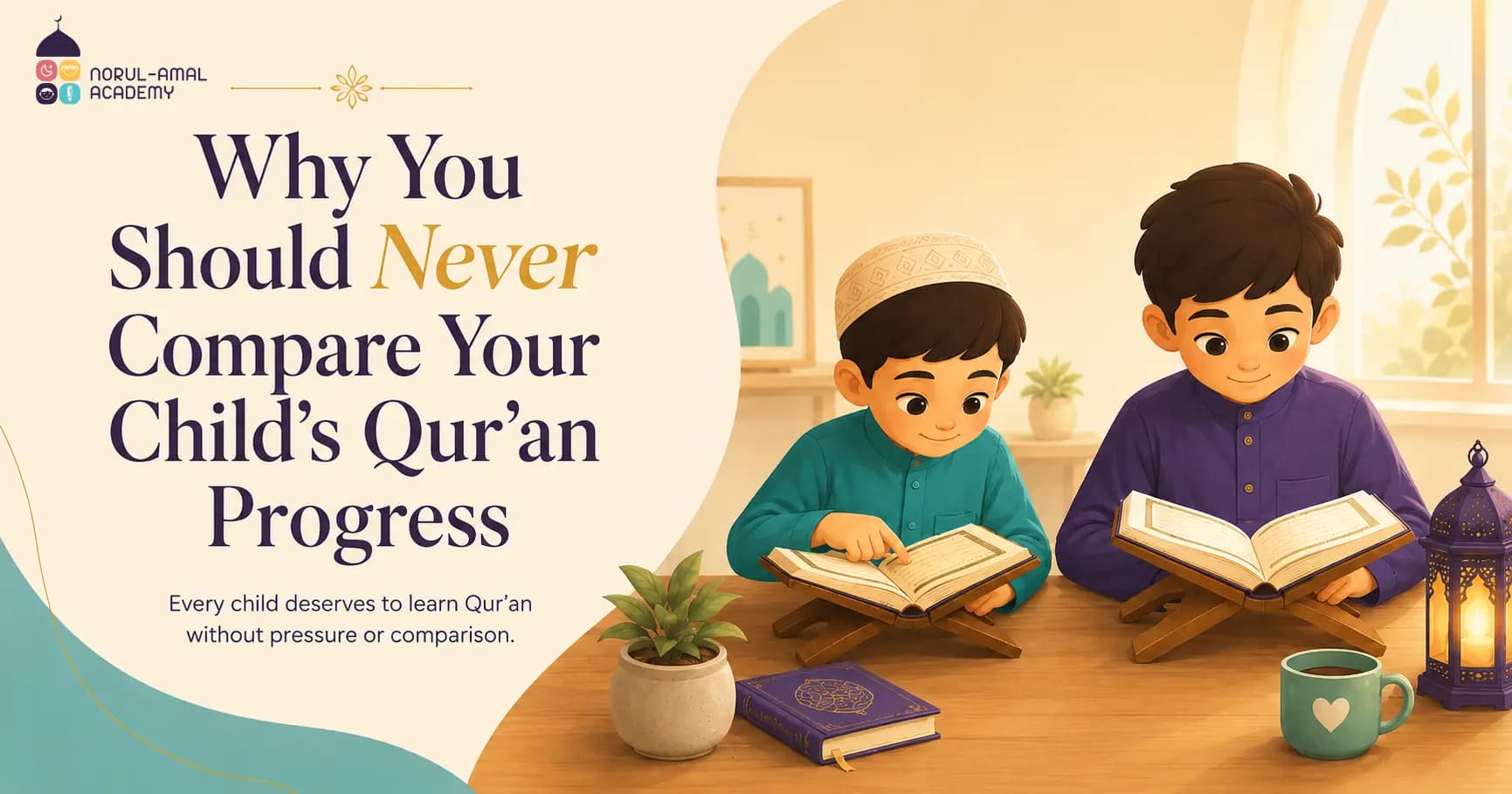
Do You Compare Your Child With Other Children?
Many parents worry when one child progresses quickly in Qur’an while another child needs more time. One child may memorise several surahs, read confidently, and remember new lessons easily. Their brother or sister may struggle to memorise the same amount or need more repetition.
This difference can make parents anxious. They may begin asking why one child is doing so well while the other appears to be falling behind. However, comparing children’s Qur’an progress is rarely helpful. Every child learns differently, and every child deserves to be taught according to their own ability, pace, and needs.
“Habibi, listen. We will do our best with both of them. But you must understand that every child is different.”
Why Do Children Learn Qur’an at Different Speeds?
Children do not all learn in the same way. Some children memorise quickly after hearing an ayah only a few times. Others need to repeat it many times before it stays in their memory. Some children are confident readers, while others need more support with Arabic letters, pronunciation, Tajweed, or concentration.
A slower pace does not necessarily mean that a child is lazy, less intelligent, or less sincere. It may simply mean that the child needs a different teaching method, more repetition, shorter lessons, or additional encouragement.
The goal of Qur’an education should not only be to see who can complete the most pages or memorise the most surahs. We want every child to develop a meaningful and positive relationship with the Qur’an. That relationship cannot be measured only by speed.
Why Comparing Children’s Qur’an Progress Can Be Harmful
Parents may compare children because they want to motivate them. A parent might say, “Look how much your brother has memorised,” or, “Your sister is younger than you and she can already read this.” The intention may be good, but the effect can be very different.
Repeated comparison can make a child feel that their effort is not recognised. Instead of thinking about how to improve, the child may begin to believe that they are simply not good enough. Qur’an lessons may then become connected with embarrassment, pressure, or disappointment.
Comparison may also affect the relationship between brothers, sisters, relatives, or classmates. It can create jealousy, sadness, competition, and negative feelings between children. The problem may begin with Qur’an learning, but it can gradually spread into school, behaviour, achievements, and other parts of life.
- One child may feel proud in an unhealthy way because they are always described as the better learner.
- Another child may feel ashamed because their progress is repeatedly criticised.
- Brothers and sisters may begin to compete for approval rather than support one another.
- A child may lose confidence even when they are genuinely trying.
- Qur’an learning may begin to feel like a test of worth rather than an act of worship and growth.
Should Parents Ever Compare Their Children?
No. Parents should not compare one child’s Qur’an progress with another child’s progress. Children have different strengths, challenges, personalities, and learning speeds. A fair comparison is between the child’s progress today and where that same child was before.
Instead of saying, “Your brother has memorised more than you,” a parent can say, “Your reading is becoming clearer,” or, “You remembered more today than you did last week.” This helps the child notice real progress without feeling that they must become someone else.
Parents can still set goals and expect effort. Avoiding comparison does not mean that children should never be corrected or encouraged to work harder. It means that correction should be based on the child’s own ability and effort, not on another child’s achievement.
How Can Parents Encourage Qur’an Progress Without Pressure?
Children need encouragement that is honest, calm, and connected to effort. The aim is not to praise everything a child does, but to help the child recognise improvement and understand that learning Qur’an takes patience.
- Notice the child’s individual improvement, even when it is small.
- Praise effort, consistency, concentration, and good manners during the lesson.
- Give the child enough time to repeat and practise.
- Avoid discussing the child’s weaknesses in front of siblings or relatives.
- Speak with the teacher about the child’s specific needs.
- Set realistic goals based on the child’s current level.
- Remind the child that learning Qur’an is not a competition with other people.
A child who needs more time should still feel respected. When parents and teachers remain patient, children are more likely to continue learning instead of becoming afraid of making mistakes.
Why One-to-One Qur’an Classes Can Help
One-to-one Qur’an classes allow the teacher to focus on one child’s level, pace, and learning style. The child does not need to keep up with a group or feel embarrassed when another student progresses faster.
In an individual lesson, the teacher can spend more time on the areas the child finds difficult. One student may need support with reading Arabic. Another may need more memorisation practice. A third may read well but need help understanding the meaning of what they recite.
This is one reason Norulamal Academy offers one-to-one Qur’an and Islamic Studies classes. We believe that every child deserves to learn without unnecessary pressure and without being treated as a copy of another child.
Individual teaching does not mean lowering expectations. It means helping each child move forward from their actual starting point. The teacher can challenge the child appropriately while still protecting their confidence and love of learning.
Every Child Deserves Their Own Qur’an Journey
One child may memorise quickly, while another child may develop beautiful recitation slowly. One may ask thoughtful questions, while another may show strong consistency. Each child can have different strengths, and all of these strengths matter.
As parents and teachers, we should do our best for every child. We should guide them, correct them, encourage them, and help them improve. But we must also remember that every child is different.
Never make your child feel that their Qur’an journey has less value because somebody else is moving faster. Help your child grow at their own pace, recognise their real progress, and continue learning with confidence.
Every child deserves to learn Qur’an at their own pace, in their own way, without pressure and without comparison.
Norulamal Academy provides one-to-one online Qur’an and Islamic Studies classes for children and teenagers, helping each student learn according to their own level and educational needs.
Frequently Asked Questions
Why does one child memorise Qur’an faster than another?
Children have different memories, attention spans, previous learning experiences, and ways of processing information. One child may memorise quickly, while another needs more repetition. Speed alone does not show how sincere, intelligent, or capable a child is. The teaching approach should be adjusted to the individual child.
Can comparison motivate a child to work harder?
Comparison may create a temporary reaction, but it can also make a child feel ashamed, jealous, or discouraged. It is usually better to motivate the child by recognising their own progress, setting realistic goals, and praising genuine effort rather than comparing them with a sibling or classmate.
What should I say when my child is progressing slowly?
Speak calmly and focus on the next achievable step. You might say, “Let us practise this part again,” or, “You are improving, and we will keep working together.” The child should understand that improvement is expected, but that needing time is not something shameful.
Are one-to-one Qur’an classes suitable for slower learners?
One-to-one classes can be helpful because the lesson can follow the child’s level and pace. The teacher can give more attention to specific difficulties, adjust the amount of memorisation, and repeat material without the child feeling pressured to keep up with a group.