
How to Teach Children to Make Du‘a
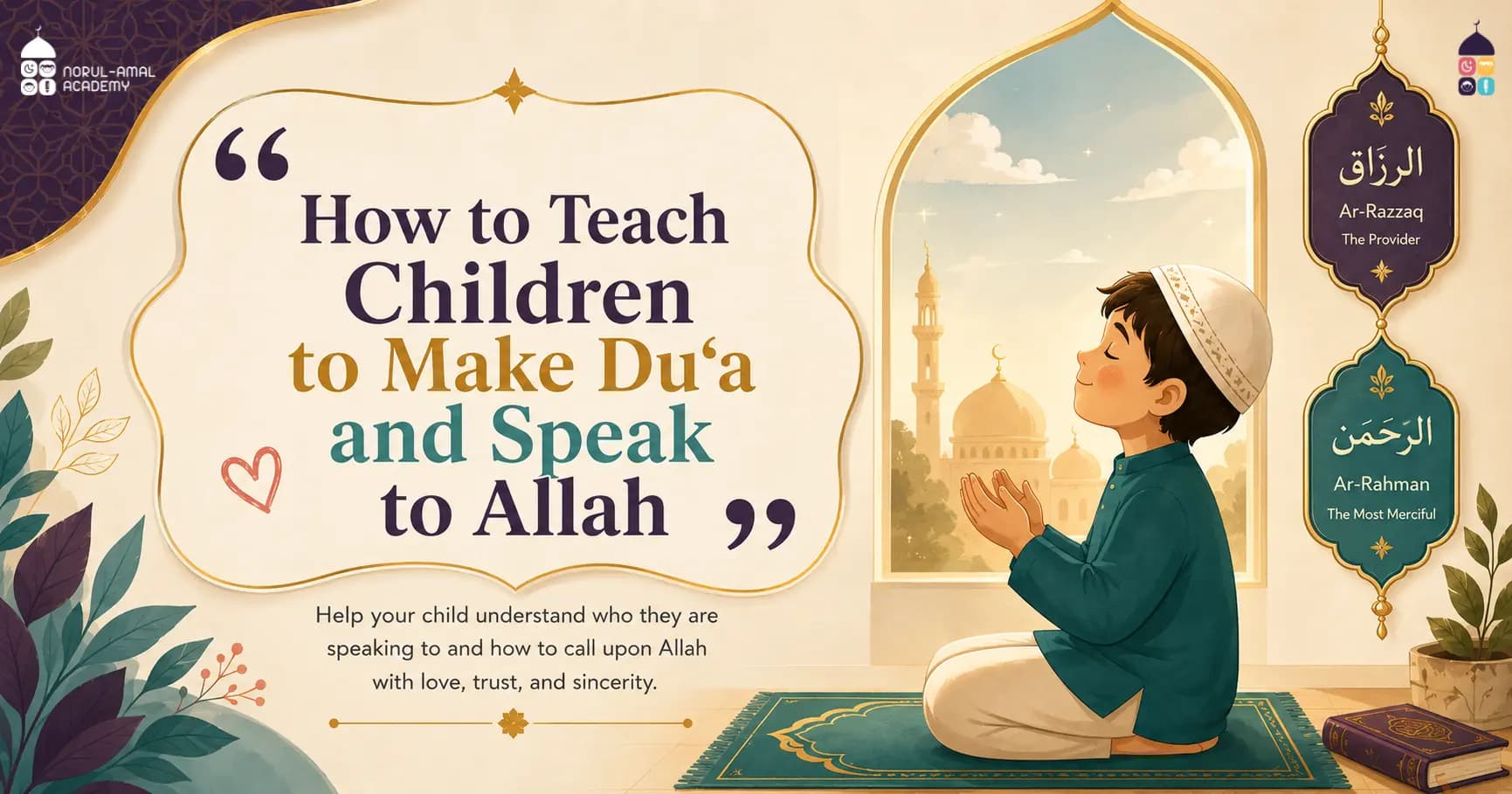
Does Your Child Know How to Speak to Allah?
Many children learn short du‘as to say before eating, sleeping, travelling, or entering the home. Memorising these du‘as is valuable, but children also need to understand that du‘a is not limited to sentences they have learnt from a book.
Du‘a allows a child to speak directly to Allah. They can ask Him for help, guidance, forgiveness, mercy, protection, or anything good. They do not need an appointment, and they do not need another person to carry their request to Him.
When we teach children how to make du‘a, the goal is not only to give them more words to memorise. We want them to understand who Allah is, why they turn to Him, and how du‘a can become part of their everyday lives.
A child can speak to Allah at any time, about anything that matters to them.
How Can We Help Children Understand the Power of Du‘a?
A child may understand the idea more easily through a simple example. Imagine that your closest friend suddenly became the president of a country. Whenever you needed help, you could call that friend directly and explain what you needed.
A child might think that would be amazing. Yet speaking to Allah is far greater. Allah is the Lord and King of everything. He hears every person, knows every need, and is never too busy to hear the du‘a of a child.
This explanation helps children understand that Allah is not distant. They can turn to Him when they are happy, worried, afraid, thankful, confused, or hoping for something good.
Du‘a Is More Than Asking for Things
Children sometimes think that du‘a means asking Allah to give them something. Asking Allah is an important part of du‘a, but du‘a also teaches worship, trust, humility, and dependence upon Him.
Before making a request, a child can begin by praising Allah. This helps the child remember who they are speaking to. They are not simply repeating a wish. They are calling upon their Creator, the One who provides, protects, forgives, and shows mercy.
Praising Allah before making a request is a beautiful etiquette of du‘a. However, children should not be made to believe that Allah will refuse to hear them if they do not use a perfect formula. A child can always turn to Allah sincerely, even when their words are simple.
Teaching Children to Call Upon Allah by His Beautiful Names
One meaningful way to teach children how to make du‘a is to connect their request to one of Allah’s beautiful names. The child begins to understand what the name means and why it relates to what they are asking for.
For example, a child who is asking Allah to provide for the family can call upon Him as Ar-Razzaq, the Provider. A child seeking mercy can call upon Allah as Ar-Rahman or Ar-Raheem, the Most Merciful.
- “O Allah, You are Ar-Razzaq, the Provider. Please provide for us.”
- “O Allah, You are Ar-Rahman, the Most Merciful. Have mercy on me.”
- “O Allah, You are Al-Ghafoor, the Most Forgiving. Please forgive me.”
- “O Allah, You are Al-Hafeez, the Protector. Please protect my family.”
- “O Allah, You are Al-Hakeem, the Most Wise. Guide me to what is best.”
These examples should not become another list that children repeat without understanding. Explain the meaning of the name, then encourage the child to make their own simple du‘a using it.
How to Teach a Child to Make Du‘a Naturally
Teaching du‘a does not always require a formal lesson. Parents can use ordinary moments throughout the day to remind children to turn to Allah.
- When a child is worried about an exam, encourage them to ask Allah to make it easy.
- When someone is ill, help the child ask Allah for healing.
- When the family receives something good, remind the child to thank Allah.
- When the child makes a mistake, teach them to ask Allah for forgiveness.
- When the child wants something, encourage them to ask Allah while trusting His wisdom.
- When the child feels afraid, remind them that they can ask Allah for protection.
The child’s words do not need to sound formal or complicated. A sincere sentence such as, “O Allah, please help me,” can be a meaningful beginning. Over time, parents and teachers can help the child learn more of Allah’s names, prophetic du‘as, and the etiquettes of supplication.
Should Children Only Memorise Du‘as?
No. Children should learn authentic du‘as from the Qur’an and Sunnah, but they should also understand their meanings and learn that they can ask Allah for their personal needs in their own words.
When children memorise without understanding, the words may remain disconnected from their hearts and daily lives. When they understand who Allah is and why they call upon Him, du‘a becomes more than a lesson to complete.
The aim is to help children build a habit of turning to Allah. A child who learns to speak to Allah during small moments may continue turning to Him during the most difficult and important moments of life.
Make Du‘a Part of Everyday Family Life
Children learn from what they regularly see. When parents make du‘a naturally, children begin to understand that calling upon Allah is part of a Muslim’s daily life.
Parents can make a short du‘a with their children before leaving the house, after receiving good news, when facing a difficulty, or when planning something important. They can also ask the child, “What would you like to ask Allah for today?”
This should feel warm and sincere rather than forced. We do not want children to see du‘a as another task they must perform perfectly. We want them to recognise it as a gift: they are able to speak directly to Allah whenever they need Him.
Help Your Child Build a Relationship With Allah
Teaching children how to make du‘a is not only about correcting the order of their words. It is about helping them know Allah, trust Him, praise Him, and turn to Him with hope.
Teach your child some of Allah’s beautiful names. Explain their meanings simply. Encourage your child to ask Allah for help in real situations, and remind them that no sincere du‘a is too small to bring before Him.
Do not teach children only the words of du‘a. Teach them about the relationship behind the words.
At Norulamal Academy, our Qur’an and Islamic Studies lessons aim to help children understand their worship and connect Islamic teachings to everyday life. Children need more than information; they need to understand why their relationship with Allah matters.
Frequently Asked Questions About Teaching Children Du‘a
How can I teach my child to make du‘a?
Begin with simple, real situations. When your child needs help, feels afraid, receives something good, or worries about something, remind them that they can speak to Allah. Teach short authentic du‘as, explain their meanings, and encourage your child to make personal requests in simple words.
Can children make du‘a in their own language?
Children can speak to Allah about their needs using words they understand. They should also gradually learn authentic Arabic du‘as from the Qur’an and Sunnah with their meanings. The goal is for the child to understand what they are saying rather than repeating sounds without connection.
Should children praise Allah before making du‘a?
Praising Allah before asking Him is a beautiful etiquette of du‘a and helps children remember who they are speaking to. Parents can teach children to praise Allah through His names, but they should also reassure them that they can turn to Allah sincerely whenever they need Him.
How can children use Allah’s names in du‘a?
Teach one name at a time, explain its meaning, and connect it to a simple request. For example, a child can say, “O Allah, You are Ar-Razzaq, the Provider. Please provide for us,” or, “O Allah, You are Ar-Rahman, the Most Merciful. Have mercy on me.”
Internal Link Recommendations
Islamic Studies lessons for children